News, Enterprise Updates
Recyclable Does Not Mean Recycled: The Data Behind Packaging Design
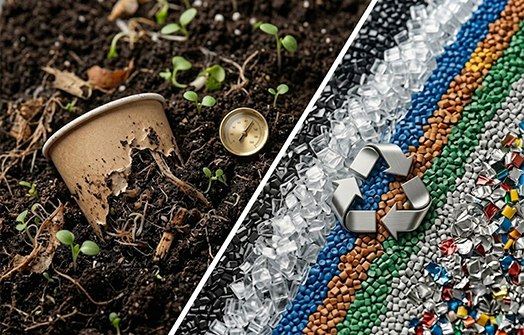
As sustainability becomes a global priority, “recyclable” has become one of the most common environmental claims in packaging. However, technically recyclable packaging is not always collected, sorted, or successfully reprocessed after use.
According to Eurostat, the European Union generated approximately 79.7 million tonnes of packaging waste in 2023, equal to 177.8 kilograms per person. Paper and cardboard accounted for around 40.4% of the total, while plastic represented approximately 19.8%. The average recycling rate for plastic packaging waste was about 42.1%.
These figures show that recycling outcomes depend on more than material choice. Packaging structure, product residue, sorting technology, collection systems, and local recycling capacity all affect whether a package can enter the recycling stream.
Why “Recyclable” Does Not Always Mean “Recycled”
Packaging may still be rejected if it contains incompatible materials, non-separable components, complex coatings, unsuitable labels, excessive residue, or parts that are too small for sorting equipment.
The OECD reported that approximately 15% of global plastic waste was collected for recycling in 2019, but only around 9% was ultimately recycled. Losses occurred during collection, sorting, cleaning, and reprocessing.
For this reason, sustainable packaging should be assessed by whether it can be identified, separated, collected, and processed at scale.
Designing for Better Recycling Outcomes
Packaging design can improve recyclability by:
- Reducing unnecessary materials and decorative components
- Prioritising mono-material structures where possible
- Making multi-material components easy to separate
- Limiting complex laminations, coatings, and adhesives
- Providing clear material and disposal instructions
- Adapting the design to local recycling infrastructure
Paper-based packaging also requires careful evaluation. Using paper does not automatically make a package more sustainable. Plastic films, aluminium layers, magnets, foams, and non-removable components may reduce fibre recovery.
Well-designed paper packaging should maximise fibre content, minimise unnecessary composite layers, and allow essential non-paper parts to be removed easily.
From Material Choice to System-Level Design
The packaging industry is moving beyond theoretical recyclability towards real-world, large-scale recycling performance.
The European Union’s Packaging and Packaging Waste Regulation is advancing requirements related to packaging reduction, recyclability, recycled content, and harmonised labelling. Sustainable packaging is therefore becoming both a design priority and a measurable compliance requirement.
Ultimately, recyclability creates environmental value only when packaging can be properly collected, identified, sorted, and reprocessed.
Conclusion
“Recyclable” describes a technical possibility. “Recycled” describes an actual environmental outcome.
The goal of sustainable packaging is not simply to replace one material with another. It is to use responsible material selection, structural optimisation, source reduction, and clear disposal guidance to improve the likelihood that packaging will successfully enter existing recycling systems.
Only when packaging can be correctly disposed of, accurately identified, effectively sorted, and successfully reprocessed can recyclability be converted into measurable environmental value.